
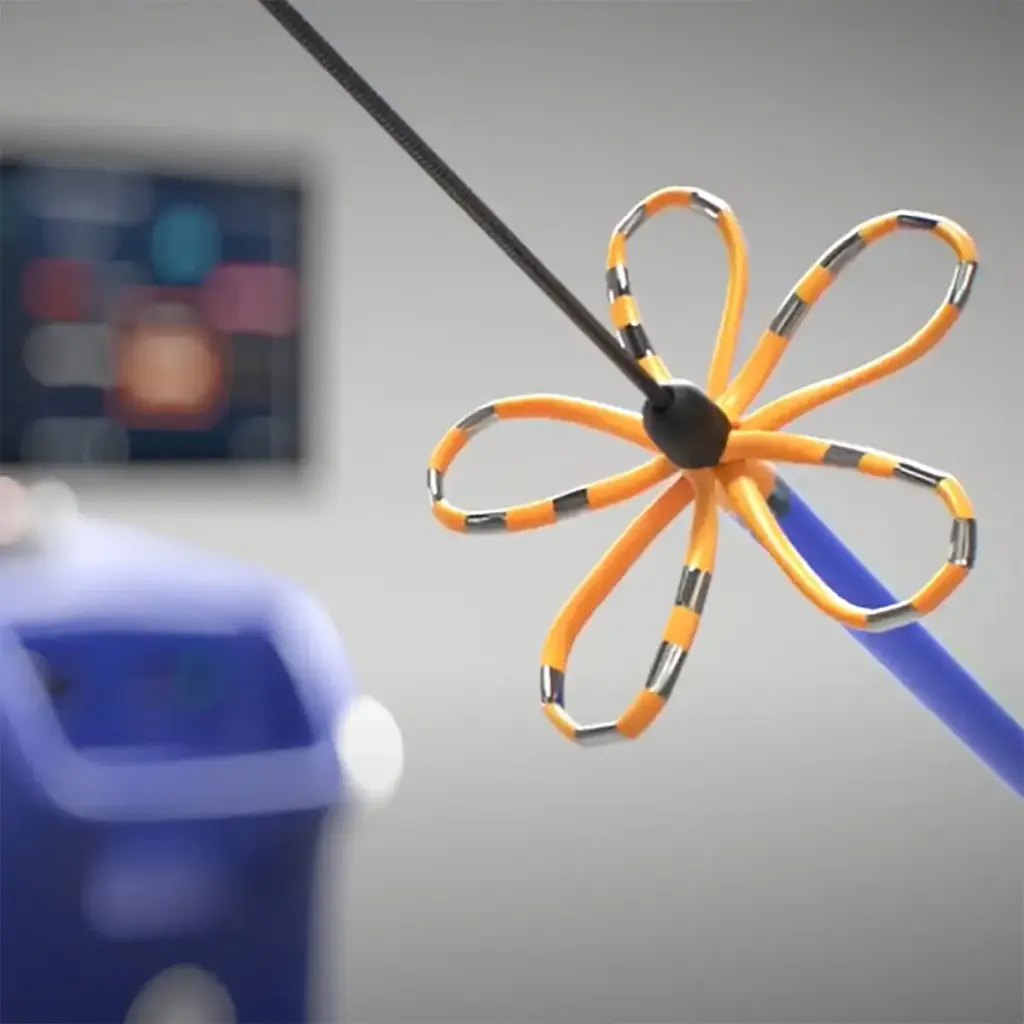
The 3-Stage Approach
Diagnose & Map
Your ECG, symptom history, and live 3D electrical mapping establish the exact trigger and short-circuit pathway causing your arrhythmia.
Targeted Ablation
Precise energy—such as next-generation Pulsed Field Ablation (PFA) or Radiofrequency warmth—is delivered to safely block the abnormal pathway.
Recover & Follow Up
Delivered as a day-case procedure with same-day discharge for most patients, supported by structured follow-up and direct access to the PA team.
What Conditions Are Treated with Catheter Ablation?
Catheter ablation treats a wide range of heart rhythm disorders (arrhythmias) when medications are ineffective, cause side effects, or when a permanent cure is preferred. These include:
Atrial Fibrillation (AF)
Paroxysmal and persistent AF
Atrial Flutter
Rapid, regular short-circuit rhythm in the atria
SVT (Supraventricular Tachycardia)
Sudden rapid racing heart episodes
WPW (Wolff-Parkinson-White) syndrome
Congenital extra electrical pathways
Atrial Tachycardia
Focal rapid electrical firing in the upper chambers
Ectopic Beats (PVCs & PACs)
Frequent skipped, missed, or extra beats
Ventricular Arrhythmias (VT)
Lower-chamber rhythm disorders
How Is Catheter Ablation Planned?
Before your procedure, your heart’s electrical activity is mapped and assessed using non-invasive and specialised diagnostic investigations:
12-Lead ECG
The first-line test recording your heart's baseline electrical signals
Ambulatory Holter Monitor
Continuous 24-hour to 14-day ECG patch monitoring to capture intermittent rhythm abnormalities
3D Electro-Anatomical Mapping
Live 3D computer mapping in the lab to pinpoint the exact origin of the short circuit
Echocardiogram
An ultrasound scan assessing the heart's chambers, valves, and overall pumping function
Ablation Energy & Treatment Techniques
Different types of ablation energy are used depending on your specific rhythm disorder, your anatomy, and whether non-thermal or thermal energy is best suited:
Echocardiogram
The newest tissue-selective, non-thermal technology using rapid electrical pulses to treat heart muscle in seconds while sparing nearby structures such as the oesophagus and nerves
Radiofrequency (RF) Ablation
Uses controlled warmth to create precise, durable microscopic barriers; the gold standard for SVT, Atrial Flutter, and focal ventricular ectopics
Cryoablation
Uses intense cold (cryoballoon) to freeze heart tissue, commonly used for pulmonary vein isolation in atrial fibrillation
3D STAR Mapping
Advanced proprietary mapping to locate complex electrical drivers in persistent atrial fibrillation
Which energy source and technique is right for you depends on your specific arrhythmia, your symptoms, and your overall heart health, assessed individually during consultation.
Why See a Heart Rhythm Specialist Rather Than a General Cardiologist?
Catheter ablation is a highly specialised sub-field of cardiology that requires advanced interventional training in cardiac electrophysiology and 3D mapping systems. Professor Finlay is a Consultant Cardiologist and Cardiac Electrophysiologist with over 20 years in cardiology and well over 1,000 ablation, pacemaker, and device procedures performed. As Arrhythmia Research Lead at Barts Heart Centre and an Honorary Clinical Professor at Queen Mary University of London, he was among the first UK physicians to adopt Pulsed Field Ablation and co-chaired the European certification committee for cardiac electrophysiology.
Frequently Asked Questions Catheter Ablation
What is the difference between catheter ablation and cardiac ablation?
They refer to the exact same procedure. “Cardiac ablation” is the general term for treating heart tissue to correct abnormal rhythms, while “catheter ablation” describes the minimally invasive method of guiding thin, flexible tubes to the heart via a leg vein.
Will I be awake during the procedure?
Most procedures are performed under local anaesthetic with light sedation so you remain relaxed and comfortable throughout. In certain complex cases, a light general anaesthetic may be used.
How long is the recovery time?
Most ablations are day cases, allowing you to go home the same day. You will need 2 to 3 days of quiet rest at home, with most patients returning to light desk work and normal routines within a week.
Will private health insurance cover catheter ablation?
In most cases, yes. Professor Finlay is recognised by all major UK private health insurers. However, policy terms vary, so you must contact your insurer beforehand to confirm your cover limits and obtain a pre-authorisation code.
What to expect on the day
Arrival & Preparation
Admitted to the private cardiac day unit; simple pre-procedure checks and consent confirmed.
Anaesthetic & Comfort
Local anaesthetic with gentle sedation (or light general anaesthetic) for total comfort.
The Procedure
Catheters are guided through a small leg vein into the heart to deliver precision treatment, usually in 1 to 2 hours.
Recovery & Same-Day Discharge
Rest in the recovery suite for a few hours before returning home the same day.
Quick facts
Duration
1 – 2 hours
Stay
Day case (same day)
Anaesthesia
Sedation or general
Recovery
2 – 3 days home rest
Discuss Catheter Ablation with Professor Finlay
Related services
Watch Professor Finlay explain
Clear, honest answers to the questions patients ask most, from ablation and AFib recurrence to pacemakers.
AFib came back after ablation
Why AFib can return after an ablation, and the options that are available next.
Watch on YouTube →When should you consider AFib ablation?
Who benefits most from ablation, and when it makes sense to consider it over medication.
Watch on YouTube →Pacemakers: a small device that makes a big difference
How pacemakers work, who needs one and what life looks like afterwards.
Watch on YouTube →AF ablation: does age really matter?
Whether age affects ablation success and safety, and what matters more.
Watch on YouTube →Your treatment journey
Consultation
Your history, ECG and a clear diagnosis (face-to-face or by video).
Plan Agreed Together
Options explained plainly, so you decide together with Professor Finlay.
Day-Case Procedure
Usually under an hour for suitable patients, home the same day.
Follow-Up & Support
Structured review and direct access to the PA team.