
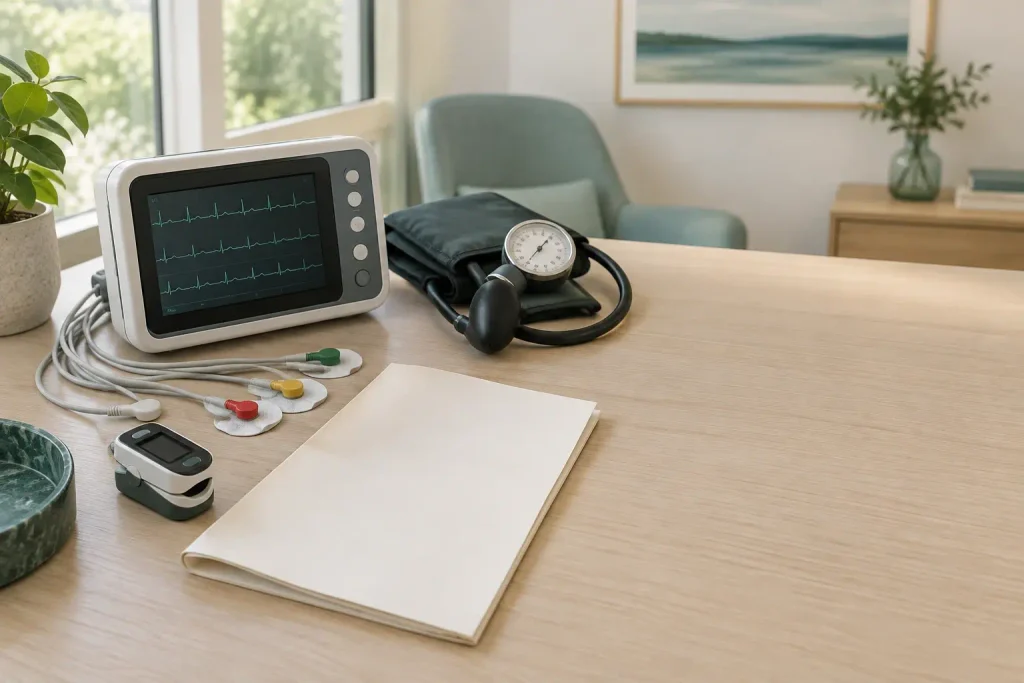
What Your Assessment Covers
Your History & Risk Factors
A detailed discussion of your personal and family history, lifestyle, and any risk factors for heart disease.
Heart Rhythm & Structure
An ECG and echocardiogram to assess your heart's electrical activity and structure directly.
A Clear, Personal Result
Your findings explained in plain terms on the day, with a written summary and any recommended next steps.
Who Is a Cardiac Health Assessment For?
A Cardiac Health Assessment suits anyone who wants reassurance about their heart health, particularly where risk factors are present, even without current symptoms.
A family history of heart disease, arrhythmia, or sudden cardiac death
Returning to exercise or starting a new fitness programme after a break
Risk factors such as high blood pressure, high cholesterol, diabetes or smoking
A pre-employment, insurance, or executive health requirement
General reassurance and a proactive approach to long-term heart health
This assessment is designed for people without acute symptoms. If you have chest pain, breathlessness, blackouts or palpitations now, please book a symptom-led appointment or, for an emergency, call 999 or attend A&E.
What Does a Cardiac Health Assessment Include?
A typical assessment combines a detailed history, examination, ECG and echocardiogram, with further tests added where indicated.
Consultation & history
Personal and family history, lifestyle and symptom review.
Blood pressure & examination
A full cardiovascular examination.
ECG
A baseline recording of your heart's electrical activity.
Echocardiogram
An ultrasound scan of the heart's structure and function.
Blood tests
Cholesterol and other relevant markers, where appropriate.
Further investigation if indicated
Such as a Holter monitor or exercise test, added only where your results suggest it would help.
Professor Finlay’s role is to work out which of these applies to you, and to rule out a rhythm disorder where one isn’t present.
What Happens After Your Assessment?
Results are discussed with you on the day, in plain terms, with a written summary to follow.
Where everything is normal, you leave with clear reassurance and, if useful, practical advice on maintaining heart health. Where something needs further attention, Professor Finlay explains exactly what has been found and what the recommended next step is, whether that’s monitoring, lifestyle changes, or further treatment.
Frequently Asked Questions About Cardiac Health Assessments
Do I need a referral for a Cardiac Health Assessment?
No GP referral is required for a private Cardiac Health Assessment, though sharing any existing test results or family history in advance is helpful.
How long does a Cardiac Health Assessment take?
Most assessments take between 45 minutes and an hour, depending on which tests are included, with results discussed at the end of the same appointment.
Will I get my results the same day?
Initial findings from your ECG and echocardiogram are usually discussed with you on the day. Where blood tests are included, those results follow within a few days, with a further discussion if needed.
Is a Cardiac Health Assessment covered by insurance?
Many insurers do not cover purely preventative or screening assessments without symptoms; some executive health or employer-funded schemes do. Please check your policy, or ask about self-pay pricing.
What to Expect on the Day
History & Discussion
Your personal and family history, lifestyle and any concerns reviewed in full.
Examination & ECG
A full cardiovascular examination and a baseline ECG.
Echocardiogram
An ultrasound scan assessing your heart's structure and function.
Results & Plan
Findings discussed with you on the day, with a written summary and any recommended next steps.
Quick facts
Duration
45 min – 1 hour
Results
Discussed the same day
Referral
Not required for private assessments
Book Your Cardiac Health Assessment with Professor Finlay
Related services
Your Assessment Journey
Book Your Assessment
Request an appointment; the PA arranges a convenient time.
Your Assessment
History, examination, ECG and echocardiogram, usually within a single visit.
Results Explained
A clear, personal discussion of what was found.
Ongoing Care if Needed
Further monitoring, lifestyle advice, or treatment arranged where relevant.